Quadratic Voting Systems: Democratic Innovation 2025
Imagine a world where your voice truly matters, where every opinion, no matter how strong or nuanced, can be expressed in a way that actually influences decisions. What if traditional voting methods aren't fully capturing the intensity of our preferences, leaving some feeling unheard and others overpowering the conversation?
Traditional voting systems, for all their benefits, often treat every issue as equally important to every voter. They lack the ability to effectively convey the strength of individual preferences. This can lead to situations where a majority, even if weakly opposed, can override the intense desires of a passionate minority, leading to dissatisfaction and a sense that the system isn't truly representative.
Quadratic Voting Systems: Democratic Innovation 2025 aims to address these challenges by providing a more nuanced and expressive way for individuals to communicate their preferences in collective decision-making. It seeks to empower individuals, ensuring that their voices are heard in proportion to the intensity of their convictions, leading to more equitable and efficient outcomes.
This article explores the exciting potential of quadratic voting (QV) as a tool for democratic innovation. QV allows individuals to express the intensity of their preferences by purchasing "votes" at a cost that increases quadratically with the number of votes purchased. This encourages thoughtful consideration of individual priorities and prevents the domination of single-issue voters. We'll delve into the mechanics of QV, its potential benefits, potential drawbacks, and its real-world applications, all while considering its implications for the future of democratic processes. Key concepts explored include preference intensity, collective decision-making, democratic innovation, and resource allocation.
A Personal Encounter with the Power of Voice
I remember being part of a local community board tasked with allocating funds for various neighborhood projects. The traditional voting system felt incredibly limiting. A few vocal individuals consistently pushed for their favored projects, often overshadowing quieter but equally important needs. I witnessed firsthand how frustrating it was for those with well-reasoned, deeply felt arguments to be outvoted simply because they weren't as assertive or didn't have the same level of social influence. Quadratic voting, in this scenario, could have leveled the playing field. Imagine if community members had been given a set number of "credits" to allocate to the projects they cared about most. The cost of each additional credit would increase, forcing individuals to prioritize and truly consider which projects were most important to them. Someone deeply passionate about a local park renovation, for example, could spend more credits to express their strong support, while someone with a more neutral stance might allocate credits to other initiatives. This nuanced approach would have likely resulted in a more balanced and representative allocation of resources, reflecting the true priorities of the community as a whole. The core of Quadratic Voting lies in this nuanced approach. It's more than just a voting mechanism; it's a tool for fostering deeper engagement and ensuring that the collective decisions reflect the true desires of the community.
What Exactly is Quadratic Voting?
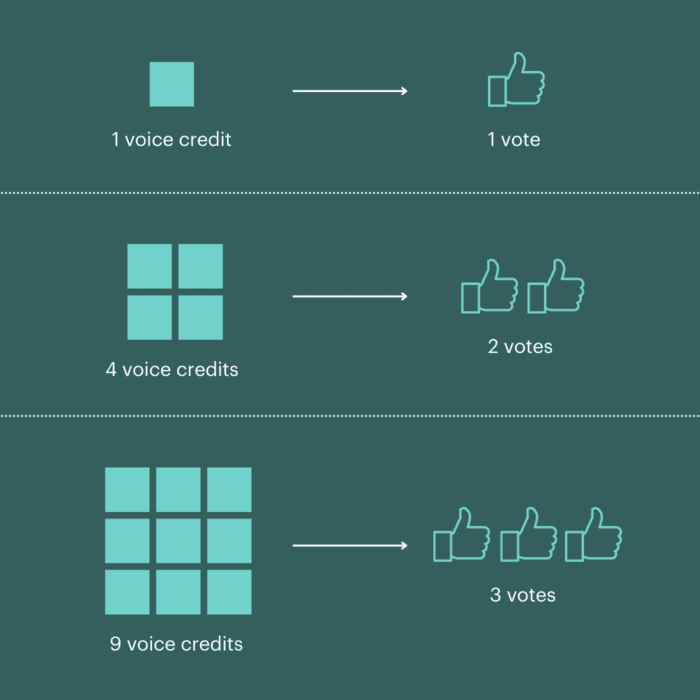
Quadratic Voting (QV) is a collective decision-making process where individuals can express the intensity of their preferences by purchasing votes. Unlike traditional voting systems, where each person gets one vote per issue, QV allows individuals to allocate their votes across different options or proposals, with the cost of each additional vote increasing quadratically. This means that the first vote might cost one credit, the second vote four credits, the third vote nine credits, and so on. This cost structure discourages individuals from spending all their votes on a single issue, encouraging them to prioritize and consider the relative importance of different options. It aims to address the limitations of traditional voting systems by providing a mechanism for individuals to express the strength of their preferences. It encourages more efficient resource allocation and reduces the potential for tyranny of the majority, where a weakly opposed majority can override the intense desires of a passionate minority. The power of QV lies in its ability to aggregate not just opinions, but also the intensity of those opinions, leading to more informed and representative collective decisions. The concept hinges on the idea that individuals should be able to express how much they care about an issue, not just whether they are for or against it. The math, while appearing complex, is designed to create a system where expressing strong preferences is incentivized, but overspending on a single issue becomes too costly.
History and Myths Surrounding Quadratic Voting
The concept of quadratic voting, while gaining traction recently, has roots in economic theory dating back to the early 2000s. It wasn't born overnight but evolved from research exploring ways to overcome inefficiencies in public goods provision. One common myth surrounding QV is that it's inherently complex and difficult to understand. While the underlying mathematics might seem intimidating, the basic principle is quite simple: the more you want something, the more you pay for it, but the cost increases at an accelerating rate. Another misconception is that QV is only applicable to large-scale elections. In reality, it can be adapted for a wide range of scenarios, from internal company decision-making to resource allocation within community organizations. The history of QV involves numerous experiments and trials in various contexts, providing valuable insights into its practical applications and potential challenges. From funding public art projects to prioritizing research initiatives, QV has demonstrated its versatility and ability to foster more equitable and efficient outcomes. The truth is that QV is not a silver bullet, but a powerful tool that can be tailored to specific needs and contexts, offering a more nuanced and expressive approach to collective decision-making than traditional methods. Its development is an ongoing process with research constantly exploring its potential.
The Hidden Secret of Quadratic Voting
The "hidden secret" of quadratic voting isn't really a secret at all, but rather a subtle consequence of its design. It's the ability to reveal the true willingness to pay for different outcomes. In traditional voting, you might vote for a particular project even if you only slightly prefer it over another. With QV, you have to put your money where your mouth is. By requiring individuals to purchase votes, QV creates a mechanism for revealing the intensity of their preferences. The higher the cost of each additional vote, the more carefully individuals must consider their priorities. This leads to a more accurate reflection of the collective will. Another subtle benefit is that QV can disincentivize strategic voting. In traditional systems, voters might vote insincerely to achieve a desired outcome. But with QV, the cost of strategic voting can be too high, encouraging individuals to vote honestly based on their true preferences. The underlying principle is that incentivizing honest expression leads to more efficient outcomes. By encouraging individuals to reveal their true willingness to pay, QV helps to allocate resources to the projects and initiatives that are most valued by the community as a whole. It unearths the true value that people place on each item being voted on.
Recommendations for Implementing Quadratic Voting
If you're considering implementing quadratic voting, start small. Don't overhaul your entire decision-making process overnight. Begin with a pilot project in a specific area where you think QV could be particularly beneficial. Clearly define the goals of the QV experiment and the metrics you'll use to measure its success. Is it to improve resource allocation? Increase participation? Foster greater engagement? Ensure that participants understand the mechanics of QV. Provide clear instructions and examples to help them grasp the concept of purchasing votes at a quadratic cost. Offer training sessions and answer any questions they may have. Consider the potential for unintended consequences. For example, if some individuals have more resources than others, they might be able to disproportionately influence the outcome. To mitigate this, you could consider allocating a fixed number of credits to each participant. Be transparent about the entire process. Explain how QV works, why you're using it, and how the results will be used. This will help to build trust and ensure that participants feel comfortable with the new system. Gather feedback from participants throughout the experiment. Ask them what they like and dislike about QV, and how it could be improved. Use this feedback to refine your implementation strategy. Finally, don't be afraid to experiment. QV is a relatively new approach to decision-making, so there's still a lot to learn. Be willing to try different variations of QV to see what works best for your specific context.
Quadratic Funding: A Close Relative
Quadratic Funding (QF) is a funding mechanism closely related to QV that leverages the principles of matching funds to amplify the impact of individual contributions to public goods. The core idea is that small donations from many individuals are matched by a larger pool of funds, with the matching amount increasing quadratically with the number of individual donors. This encourages grassroots support for projects and initiatives that are valued by the community. The quadratic formula ensures that projects with a large number of small donors receive a significantly larger share of the matching funds than projects with only a few large donors. QF is particularly well-suited for funding open-source software, scientific research, and other public goods that benefit from broad support. It helps to overcome the free-rider problem, where individuals are reluctant to contribute to public goods because they can benefit from them regardless of whether they contribute. QF incentivizes individuals to contribute, even if their individual contributions are small, because they know that their contributions will be matched and amplified. It fosters a more democratic and participatory approach to funding public goods, empowering communities to directly support the projects they value most. It leverages the power of collective action to ensure that resources are allocated efficiently and equitably.
Tips for Participating in Quadratic Voting Systems
Before participating in a Quadratic Voting System (QVS), take some time to understand the issues at hand. Research the different options or proposals and consider their potential impact on you and the community. Think carefully about your priorities. What issues are most important to you? Which options or proposals do you feel most strongly about? Don't just blindly allocate your votes based on impulse. Consider the cost of each additional vote. Remember that the cost increases quadratically, so it's important to prioritize and allocate your votes strategically. Start by allocating votes to the issues you care about most. As you allocate more votes, consider the diminishing returns. Is the additional benefit of another vote worth the increased cost? Don't be afraid to experiment with different voting strategies. Try allocating your votes in different ways to see what feels most effective. If you're unsure how to allocate your votes, consider consulting with others. Talk to your friends, neighbors, and colleagues about the issues at hand. Share your perspectives and listen to theirs. Pay attention to how other people are allocating their votes. This can give you insights into the collective will and help you to refine your own voting strategy. Remember that QVS is designed to reflect the intensity of your preferences. Don't be afraid to express your true feelings. If you care deeply about an issue, allocate your votes accordingly.
Addressing Potential Challenges
While Quadratic Voting (QV) offers many potential benefits, it's important to acknowledge and address potential challenges. One concern is the potential for manipulation. Individuals with more resources could potentially purchase more votes and disproportionately influence the outcome. To mitigate this, it's important to allocate a fixed number of credits to each participant. Another challenge is the potential for voter apathy. If individuals don't understand the mechanics of QV or don't believe that their votes will matter, they may be less likely to participate. To address this, it's important to provide clear and concise information about QV and to demonstrate how it can lead to more equitable and efficient outcomes. Another concern is the potential for collusion. Groups of individuals could potentially collude to purchase votes and manipulate the outcome. To mitigate this, it's important to implement safeguards against collusion, such as auditing voting patterns and penalizing suspicious behavior. Another challenge is the potential for complexity. QV can be more complex than traditional voting systems, which can make it difficult for some individuals to understand. To address this, it's important to simplify the interface and provide clear and concise instructions. By acknowledging and addressing these potential challenges, we can ensure that QV is implemented in a way that is fair, equitable, and effective.
Fun Facts About Quadratic Voting
Did you know that the "quadratic" in Quadratic Voting refers to the mathematical formula used to calculate the cost of each additional vote? The cost increases proportionally to the square of the number of votes purchased. One of the earliest real-world applications of QV was in the context of internal decision-making at a software company. Employees used QV to allocate resources to different projects and initiatives. Some research suggests that QV can lead to more efficient resource allocation than traditional voting systems, particularly when there are strong differences in opinion. QV has been used to fund public goods, such as open-source software and scientific research. The concept of QV has even been explored in the context of urban planning, with some cities considering using it to allocate resources to different neighborhood projects. One of the key benefits of QV is that it encourages individuals to consider the relative importance of different issues. By requiring them to purchase votes, it forces them to prioritize and make trade-offs. QV is not just a theoretical concept. It's being actively researched and implemented in a variety of contexts around the world. Its design forces participants to deeply engage with the voting subject.
How to Implement Quadratic Voting
Implementing Quadratic Voting (QV) requires careful planning and execution. First, define the scope of the decision-making process. What issues will be subject to QV? Who will be eligible to participate? Second, determine the budget or resources that will be allocated through QV. How many credits will each participant receive? How will the credits be distributed? Third, choose a platform for implementing QV. There are several online platforms that offer QV functionality, or you can develop your own custom solution. Fourth, clearly communicate the rules of QV to participants. Explain how QV works, how credits are allocated, and how the results will be used. Fifth, provide training and support to participants. Answer any questions they may have and help them to understand the mechanics of QV. Sixth, monitor the voting process and address any issues that arise. Are there any signs of manipulation or collusion? Are participants having difficulty using the system? Seventh, analyze the results of the QV process. How were the credits allocated? What were the most popular options or proposals? Eighth, evaluate the effectiveness of QV. Did it lead to more equitable and efficient outcomes? Did it increase participation and engagement? Ninth, make adjustments to your QV implementation based on your evaluation. What worked well? What could be improved?
What If Quadratic Voting Became Mainstream?
If Quadratic Voting (QV) were to become mainstream, the potential implications for democracy and collective decision-making would be profound. We might see a shift towards more nuanced and representative outcomes, as QV allows individuals to express the intensity of their preferences, not just their binary choices. This could lead to greater satisfaction with the democratic process and a stronger sense of civic engagement. Resource allocation might become more efficient, as QV encourages individuals to reveal their true willingness to pay for different options or proposals. This could lead to better outcomes for public goods and services. Special interest groups might have less influence, as QV makes it more difficult for them to dominate the decision-making process with concentrated resources. This could level the playing field and give ordinary citizens a greater voice. However, there are also potential downsides to consider. QV could be more complex than traditional voting systems, which could make it difficult for some individuals to understand and participate. There is a risk of manipulation, as individuals with more resources could potentially purchase more votes and disproportionately influence the outcome. It is possible that society could shift to a resource based caste system. Despite the risk, QV offers a promising vision for a more democratic and equitable future, but it's important to address the potential challenges and implement safeguards to ensure that it is used effectively and fairly.
Listicle: Top Benefits of Quadratic Voting
1. Express the intensity of your preferences: Unlike traditional voting, QV allows you to show how strongly you feel about an issue.
2. More nuanced outcomes: QV can lead to decisions that better reflect the collective will, taking into account the strength of individual preferences.
3. Efficient resource allocation: QV encourages individuals to reveal their true willingness to pay, leading to better use of resources.
4. Reduces the power of special interests: QV makes it harder for wealthy groups to dominate decision-making.
5. Increased civic engagement: QV can encourage people to be more involved in the democratic process.
6. Fosters thoughtful consideration: The cost structure of QV encourages individuals to prioritize and think carefully about their choices.
7. Adaptable to various contexts: QV can be used in many different situations, from company decisions to community projects.
8. Encourages honest expression: The design of QV discourages strategic voting and promotes sincere expression of preferences.
9. Promotes equitable outcomes: QV helps to level the playing field and give a voice to those who might otherwise be marginalized.
10. Facilitates collective action: QV can help communities to overcome the free-rider problem and fund public goods more effectively.
Question and Answer Section
Question 1: Is Quadratic Voting more complicated than traditional voting methods?
Answer: Yes, Quadratic Voting (QV) is more complex than traditional voting, as it involves allocating a budget of credits and considering the increasing cost of each additional vote. However, the core principle – expressing the intensity of your preferences – is relatively straightforward.
Question 2: Could wealthier individuals or groups unfairly influence the outcome of a QV vote?
Answer: Yes, this is a valid concern. To mitigate this, implementations often include a fixed credit allocation to each participant, preventing those with more resources from simply buying their way to a desired outcome.
Question 3: What are some real-world examples of Quadratic Voting being used?
Answer: QV has been used in various contexts, including internal decision-making in companies, funding of open-source projects, and even for allocating resources in urban planning initiatives.
Question 4: Does Quadratic Voting guarantee a "perfect" outcome that everyone agrees with?
Answer: No, like any voting system, QV doesn't guarantee universal agreement. However, it aims to produce a more nuanced and representative outcome that better reflects the collective preferences of the participants, even if some individuals are not entirely satisfied.
Conclusion of Quadratic Voting Systems: Democratic Innovation 2025
Quadratic Voting represents a significant step towards more nuanced and representative democratic processes. By allowing individuals to express the intensity of their preferences, it addresses the limitations of traditional voting systems and offers the potential for more efficient resource allocation and greater civic engagement. While challenges remain, and careful implementation is crucial, the promise of QV as a tool for democratic innovation is undeniable. As we move closer to 2025, exploring and experimenting with QV and related mechanisms like Quadratic Funding could pave the way for a future where every voice truly matters and collective decisions reflect the true desires of the community. This is just one step toward the future of voting.
Post a Comment